
What This Guide Covers
- What a bonded and insured cleaning service actually means
- Bonded, insured, background-checked: what each one protects
- The part nobody advertises: “insured” is not one single thing
- How to verify a bonded and insured cleaning service before the first visit
- Where these protections matter most in Delaware, Pennsylvania and New Jersey homes
- What a claim actually looks like: a walk-through example
- Our own standards, stated plainly
- Is a bonded cleaning service the same as an insured one?
- Do I need a bonded and insured cleaning service for a one-time move-out clean?
- How often should I re-check a cleaning company’s coverage?
- Why do so many companies say “bonded and insured” when the coverage varies so much?
- Does hiring a bonded and insured cleaning service change what you pay?
- What should I ask a cleaning company before the first visit?
Direct Answer: A bonded and insured cleaning service carries two separate protections: a bond that reimburses you if an employee steals or the job is abandoned, and insurance that covers accidental property damage and worker injuries inside your home.
You are comparing cleaning companies on your phone. One website says “licensed, bonded, and insured.” Another says “fully insured.” A Nextdoor thread points you to someone who has cleaned in the neighborhood for years and has never had a problem. All of it sounds equally safe, so most people stop reading and pick based on availability.
Those phrases are not interchangeable, and the gap between them is where homeowners get hurt. A bonded and insured cleaning service is not simply a nicer version of an insured one, because bonding, insurance and background screening solve three different problems. A company can carry one, skip another, and still describe itself in the same reassuring language as a company that carries all three.
This guide covers three things: what each term protects you from in plain English, the coverage gap that almost nobody mentions when they advertise, and the exact questions to ask before anyone with a key walks into your house. If you would rather talk it through with a person, call our office at 302-500-9137 or send us your questions here.

What a bonded and insured cleaning service actually means
A bonded and insured cleaning service has bought two different financial products from two different kinds of company. Bonding comes from a surety provider. Insurance comes from an insurance carrier. They are not tiers of the same thing, and one does not upgrade into the other.
Bonding, in this industry, usually means a janitorial service bond, sometimes called a fidelity bond or surety bond. It exists to reimburse you, the client, if a cleaner takes something from your home or the company takes your money and never performs the work. Here is the part that surprises people: the surety pays your claim, and then the cleaning company has to pay the surety back. A bond is a guarantee to the customer, not a cushion for the business.
Insurance works the other way around. General liability insurance covers accidental property damage caused during service, like a cracked cooktop or a ruined hardwood finish. Workers’ compensation covers medical bills and lost wages if a cleaner is injured while working in your home. That second one matters more than most homeowners realize, because without it an injury claim can land on your homeowners policy.
Background screening is the odd one out. It is not a financial product at all, and no third party pays anybody. Screening is preventative. Insurance and bonding are what happen after something has already gone wrong.
Bonded, insured, background-checked: what each one protects
Each term covers a different failure, and the fastest way to see it is side by side.
| Protection | What it covers | What it does NOT cover | Who pays you |
|---|---|---|---|
| Janitorial or surety bond | Employee theft, dishonest acts, work paid for and not delivered | Accidental damage, worker injuries | The surety company, which the cleaner then repays |
| General liability insurance | Accidental damage to your property during service | Theft, injuries to the cleaning crew | The company’s insurance carrier |
| Workers’ compensation | Medical costs and lost wages if a cleaner is hurt in your home | Anything that happens to your property | The company’s workers’ comp carrier |
| Background checks | Screens out risk before anyone is hired or sent to your address | Nothing financially, it pays out zero | Nobody, it is prevention rather than reimbursement |
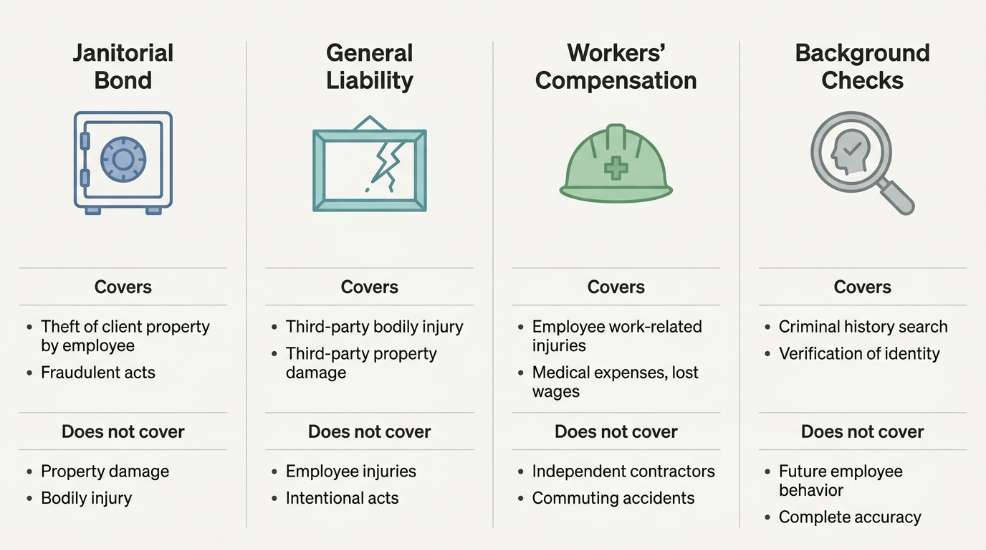
The common mistake becomes obvious once the columns sit next to each other. A homeowner whose antique mirror gets knocked off the wall does not have a bond claim. A homeowner whose ring disappears does not have a liability claim. People hear “bonded and insured cleaning service” and picture one big safety net. It is closer to four small nets, each hung under a different part of the room.
The three specifics worth memorizing, with the mistake that goes with each:
- Bonded. Best for peace of mind about theft and no-shows. Common mistake: assuming the bond also pays for a broken vase. It does not.
- Insured. Best for accidental damage and crew injuries. Common mistake: hearing “insured” and assuming it includes workers’ comp. Plenty of companies carry general liability only.
- Background-checked. Best for reducing the odds that anything happens at all. Common mistake: assuming every company screens every technician, including seasonal or subcontracted help.
The part nobody advertises: “insured” is not one single thing
Here is the problem the industry does not put on its homepage. Two companies can both advertise a bonded and insured cleaning service and offer wildly different protection, because “insured” is marketing language rather than a regulated term with a fixed meaning. A bare-minimum general liability policy and a full package of liability, workers’ comp and an active bond get described with the same three words on the same kind of van, and neither company is lying.
The technical reason is structural. Cleaning companies staffed with independent contractors often carry no workers’ compensation at all, because contractors are not employees. If a contractor slips on your stairs and there is no workers’ comp behind that injury, the claim can travel toward your homeowners policy instead. Certificates also expire. A policy that lapsed in March looks identical, on paper, to one active through next year.
How to protect yourself without becoming an insurance expert:
- Ask for a Certificate of Insurance, called a COI, before you book rather than after the first visit.
- Check that the business name on the certificate matches the name on your quote exactly.
- Look at the effective dates, not just the coverage types.
- Call the carrier listed on the certificate and confirm the policy is active. The cleaning company is not the right source to verify the cleaning company.
- Ask directly whether the people entering your home are employees or subcontractors, because the answer changes which coverage applies.

One question does most of the work: “Are the technicians who will be in my home your employees, and are they covered by your workers’ compensation policy?” A company with clean paperwork answers that in a sentence. Hesitation is your answer.
How to verify a bonded and insured cleaning service before the first visit
Verifying a bonded and insured cleaning service takes about thirty minutes and happens before any money moves. Every step below is something a legitimate company expects to be asked.
Start with the paperwork. Request the COI and, if bonding matters to you, the bond details separately, because a single document rarely proves both. Read the insurer name, policy numbers, coverage types and dates. Then call the insurer, not the cleaner, and ask whether the policy is current and the named insured matches.
Move to public record next. A single unhappy review means very little. A pattern of unresolved disputes means a lot. Our Better Business Bureau profile is the kind of page worth checking on any company you are considering, since it shows accreditation status, years in business and how complaints were handled. The same goes for a Google Business Profile, where the review history is public and hard to curate.
Finish with the human questions. Ask who is assigned to your home, whether it is the same team each visit, and what the written policy is when something is damaged or missed. The feedback our clients leave keeps circling back to those exact points rather than to paperwork, which tells you what actually shapes the experience week to week. Companies that dodge these questions early tend to dodge them later, when it matters more.
Where these protections matter most in Delaware, Pennsylvania and New Jersey homes
Coverage matters most when nobody is watching and when the house itself raises the stakes. A few situations from the kind of work we do across the region:
- Keyless entry or lockbox access. A recurring client in Newport or Bear who works standard hours is almost never home during service. Screening and bonding carry the weight here, because trust is the entire arrangement.
- Older housing stock. Narrow stairs in a Philadelphia rowhome or a century-old staircase in Bellefonte raise the odds of a fall. Workers’ compensation is the coverage that keeps that injury away from your policy.
- Move-out cleans on a deadline. A tenant in Wilmington who prepays for a move-out clean and gets a no-show loses a security deposit, not just a cleaning. That is a bond scenario, not an insurance one.
- Vacation rental turnovers. A Rehoboth Beach or Dewey Beach property changing guests on a Saturday has a few hours of margin and a lot of guest belongings moving through it.
- Post-construction work. Fresh finishes in a Middletown or Garnet Valley renovation are the easiest surfaces in a house to damage, and the most expensive to redo.

Where a bonded and insured cleaning service matters less, honestly: a short one-time clean of an empty apartment, with you present, nothing valuable on site and no prepayment. The bond has little to protect and there is no deposit at risk. Even then, general liability still matters, because damage does not care whether the job was small.
Ready to ask these questions of someone? Send us a message or call 302-500-9137, and we will answer every one before you commit to anything.
What a claim actually looks like: a walk-through example
The following is a composite example, not a specific client, built from the situations that come up most often in this line of work.
Picture a family in Greenville with a recurring biweekly schedule and a lockbox. During one visit, a cleaner catches a cord and a floor lamp goes over, chipping the edge of a granite counter on the way down. Nothing was stolen and nobody was hurt. This is a general liability claim, full stop. The bond is irrelevant. Background checks are irrelevant. The homeowner calls the company, the company files it with its liability carrier, and the repair moves forward on the carrier’s timeline instead of the family’s savings.
Now change one detail. The same family finds a piece of jewelry missing after a visit. Different claim entirely, different payer, different investigation. If the company carries a bond, there is a formal claims process with a neutral third party. If it does not, the homeowner is negotiating directly with the business that may have caused the loss. That is the whole argument for bonding in one sentence, and it is why a bonded and insured cleaning service is a meaningfully different thing from an insured one.
Our own standards, stated plainly
Since this article asks you to interrogate every bonded and insured cleaning service on your list, here is where we stand, stated without a badge. Bruna’s Cleaning Services has been working in Delaware and the surrounding region since 2014. Our cleaning professionals are licensed and insured, and every member of the team goes through a background check before being assigned to a home. We have been a BBB Accredited Business since December 2025. Those are the specifics, and we will put them in writing for you.
We would rather you ask us for that documentation than take our word for it, and we would rather you ask every company on your list the same way. Our about page explains how our team is screened and trained. The same faces show up each visit whenever scheduling allows, which is a form of security no certificate captures.
One honest limit worth naming: no amount of paperwork prevents a mistake. What paperwork does is decide who absorbs it. That is the correct reason to care about any of this.

Frequently Asked Questions
Is a bonded cleaning service the same as an insured one?
No, the two protect against different failures. A bond reimburses you for theft or for work paid for and never delivered, while insurance covers accidental property damage and injuries to the crew. Ask about each separately, because a company can carry one without the other.
Do I need a bonded and insured cleaning service for a one-time move-out clean?
Yes, and arguably more than for recurring service. Move-out cleans usually involve prepayment, a lease deadline and an empty home with nobody supervising, which is exactly the gap a bond covers. Insurance still matters too, since empty homes have exposed floors and fixtures that are easy to damage.
How often should I re-check a cleaning company’s coverage?
Once a year is a sensible rhythm, because policies and bonds run on annual terms and lapse quietly. Ask for a current Certificate of Insurance at renewal rather than assuming last year’s document still applies. Re-ask sooner if the company changes ownership, rebrands, or starts sending a different crew.
Why do so many companies say “bonded and insured” when the coverage varies so much?
Because the phrase is marketing language, not a regulated certification with a fixed definition. No agency audits how a cleaning business uses those words, so a minimal liability policy and a full package get described identically. The variation lives in the policy type, the limits, whether workers’ compensation exists, and whether everything is currently active.
Does hiring a bonded and insured cleaning service change what you pay?
Coverage is a real business expense, so it is one of several factors shaping a company’s rates, alongside home size, frequency, scope of work and crew size. The comparison people skip is what an uncovered incident costs, since a damaged stone counter can dwarf the difference. Ask what is included in the scope rather than comparing headline numbers.
What should I ask a cleaning company before the first visit?
Ask six things: can you send a current Certificate of Insurance, are technicians employees or subcontractors, do you carry workers’ compensation, are you bonded, is every technician background checked, and what happens in writing when something is damaged or missed. Ask before booking rather than after. Any company worth hiring answers all six without friction.
The short version
The three parts of a bonded and insured cleaning service answer three different questions: who pays if something is stolen, who pays if something breaks, and who is standing in your kitchen in the first place. Learning the difference takes ten minutes and it is the cheapest protection you will ever buy on a home service.
Choosing a bonded and insured cleaning service, or deciding which of those protections you actually need, should never depend on how confident a website sounds. Ask for the documents, call the carrier, check the public record, and hire the company that makes all of that easy. If you want to start that conversation with us, call 302-500-9137 or get in touch with our team and ask us every question on this page.
Bruna’s Cleaning Services
300 Cassidy Drive, Suite #305, Newport, DE 19804
Phone: 302-500-9137
Email: info@brunascleaningservice.com
Hours: Monday to Thursday 7:30 AM to 5:30 PM, Friday 7:30 AM to 5:00 PM, Saturday 8:00 AM to 2:00 PM, closed Sunday
