
Table of Contents
- How to Prepare Your Home for House Cleaning With Dogs
- Where Should Your Dog Stay While the Cleaners Work?
- The Drying Window: What Nobody Warns Dog Owners About
- What a Cleaning Team Does Differently in a Dog Household
- How Often Should You Book House Cleaning With Dogs?
- What a Typical Visit Looks Like in a Dog Household
- Is a pet-friendly cleaning service actually different from a regular one?
- Can I leave my dog loose in the house during the cleaning?
- How often should a home with two shedding dogs be cleaned?
- Why does my house still smell like dog after a cleaning?
- What affects the cost of house cleaning with dogs?
- What should I ask a cleaning company before booking if I have a dog?
- Getting Ready for Your First Visit
Direct Answer: House cleaning with dogs works best when you tell your cleaning company about your dog before the visit, decide in advance where the dog will stay, and keep him off freshly cleaned floors until every surface is completely dry.
Your dog hears the van door before you do. By the time the crew reaches the porch, he is already at the window, barking at people who came to help.
House cleaning with dogs is not the same job as cleaning an empty house, and most homeowners find that out on the first visit. There is hair in places you never look. There are paw prints on a floor that was mopped twenty minutes ago. And there is a fair question about whether the products being used are safe for an animal who licks his own feet.
This guide covers three things: how to get your home and your dog ready before the team arrives, what actually changes in the cleaning routine when a dog lives in the house, and how to handle the gap between when a surface gets cleaned and when it is safe for your dog to walk on it. Words like “pet-safe,” “non-toxic,” and “eco-friendly” get used loosely across this industry, so we will also be clear about what those labels do and do not tell you.
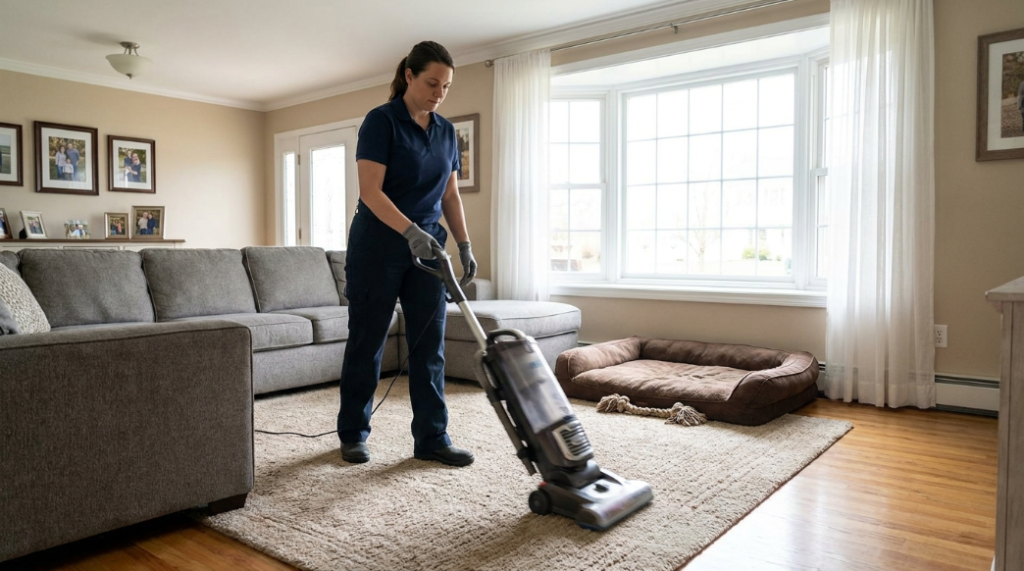
How to Prepare Your Home for House Cleaning With Dogs
Preparation for house cleaning with dogs takes about ten minutes, and it starts with one conversation. Tell the company you have a dog when you book, not when the crew is standing at your door.
Cover more than the fact that a dog exists. Say how many, roughly how big, and how they behave when a stranger walks in. Some cleaning technicians have dog allergies of their own, which is another reason this belongs at booking.
Ten minutes of physical prep covers the rest:
- Pick up chew toys, bowls, and bedding from any floor that will be mopped.
- Point out accident spots. A crew cannot treat a stain nobody mentioned.
- Decide where your dog will be during the visit and tell the team on arrival.
- Note any room your dog guards or considers his, so nobody walks in cold.
- Mention human allergies in the household, since that changes product choice.
If you want to get ahead of the product question before you book, our guide on pet-friendly cleaning solutions breaks down which product types hold up in a Delaware home without creating a problem for the dog. When you are ready to schedule, tell us about your dog when you get in touch and we will build the visit around him.
Where Should Your Dog Stay While the Cleaners Work?
Your dog should stay wherever he is calmest and out of whichever rooms are being actively cleaned. For some dogs that means a crate in a back bedroom. For others it means a long walk with a family member while the floors get done.
The right answer depends less on your dog’s size than on how he handles noise and strangers. Vacuums are the usual trigger. Dogs hear a much wider range of frequencies than people do, so a motor’s high whine lands differently for them, and barking, pacing, drooling, hiding, or lunging at the machine are recognized stress responses rather than bad behavior.
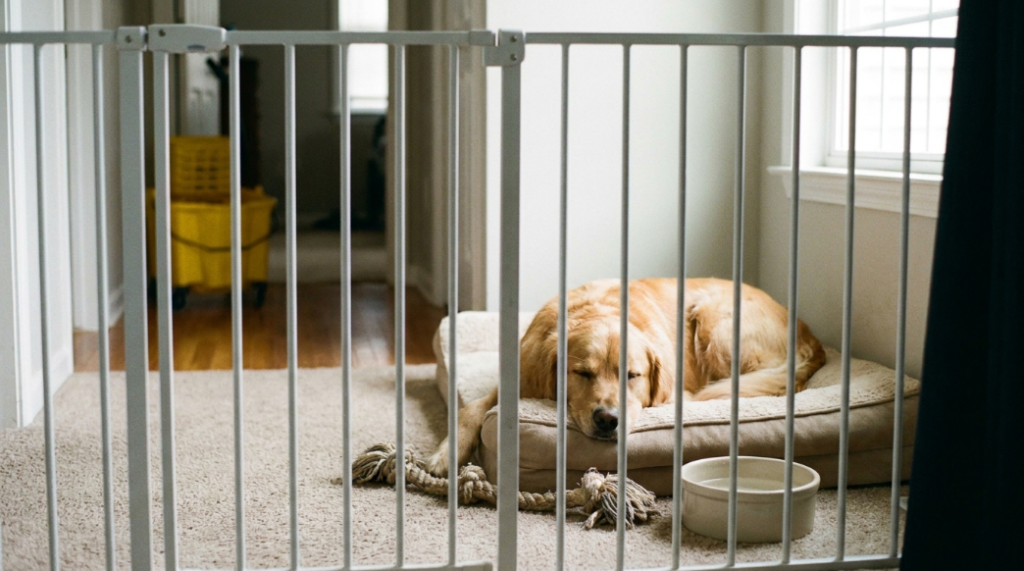
This table covers the setups that work most often when cleaning a house with dogs present:
| How your dog usually behaves | Best setup during the visit | What to tell the crew |
|---|---|---|
| Calm, sleeps through noise | Loose in a room that has already been finished | His name and which room he is in |
| Friendly but follows people everywhere | Closed in one room with water and a chew | That he will bark when that door opens |
| Crate trained | Crate moved to the quietest room in the house | Not to open the crate for any reason |
| Nervous around strangers or vacuums | Out of the house: a walk, daycare, or a relative | Roughly when he will be back |
| Has snapped, guarded, or bolted before | Off site, no exceptions | That no pets will be in the home |
There are visits where keeping your dog home stops making sense. A regular maintenance clean is short and predictable. A deep clean or a post-construction clean means more rooms open at once, equipment running for longer stretches, and doors propped while people carry things in and out.
Plan on getting your dog out of the house when any of these apply:
- He has slipped through an open door before.
- Carpets or upholstery are being treated and need drying time.
- He guards food bowls, doorways, or one particular room.
- He already struggles with thunderstorms or fireworks, since noise sensitivity tends to carry over.
The Drying Window: What Nobody Warns Dog Owners About
The riskiest stretch of house cleaning with dogs is not the cleaning itself. It is the half hour afterward, when the crew has packed up, floors are still damp, and your dog finally gets released from the back bedroom.
The reason is physical. Your dog walks across every treated surface, then licks his paws. He breathes at floor level, closer to residue than you ever get. If his water bowl sits on a floor that was just mopped, he drinks next to it.
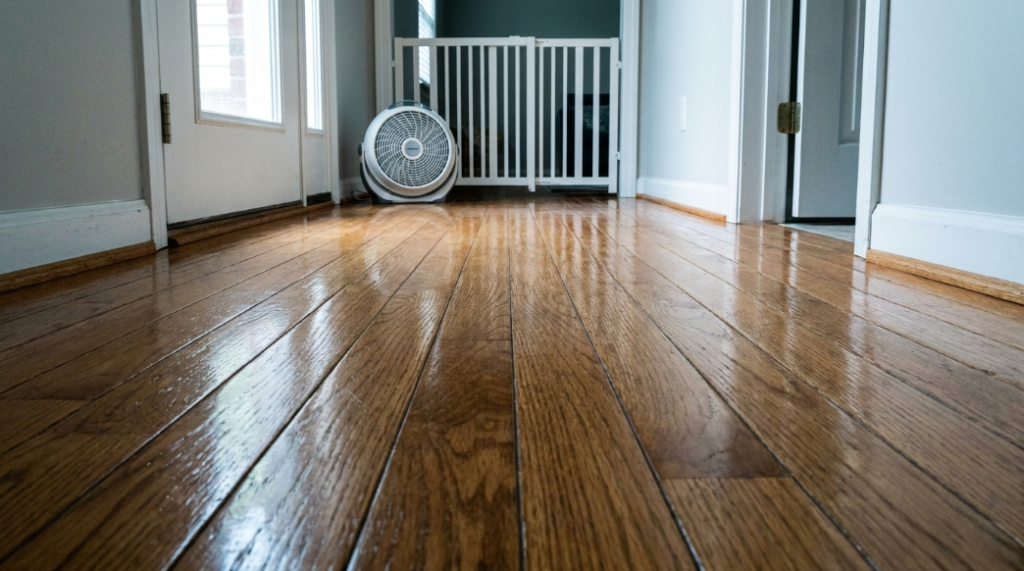
The headline from the ASPCA’s Animal Poison Control Center is reassuring: most cleaning products are safe around dogs and cats when they are used according to the label. The specific cautions are what matter. Carpet shampoo should be allowed to dry before a dog walks on it. Enzyme cleaners, the standard tool for urine odor, can cause mild stomach upset and also need to dry first. Carpet powders should be vacuumed up before pets come back into the room.
Essential oils are the real outlier. The ASPCA does not recommend using them in areas pets can access unless a veterinarian has signed off, which is worth knowing given how many products marketed as natural are built around them. “Natural” and “safe around your dog” are not the same claim.
What actually protects your dog:
- Keep him out of a room until every surface in it is dry to the touch, including edges and baseboards, not just the middle of the floor.
- Move food bowls, water bowls, bedding, and floor toys out of rooms being cleaned, then put them back after.
- Open a window or run a fan in bathrooms, where fumes concentrate fastest in a small space.
- Ask for toilet lids to be left down if your dog drinks from them.
- Have floors rinsed with plain water when a stronger product was needed for a specific job.
Before you book anyone, ask one question: what goes on my floors, and how long should my dog stay off them? A company that cannot answer the second half of that question has not thought the problem through. It also helps to keep the ASPCA Animal Poison Control Center number, 888-426-4435, somewhere you could find it in a hurry. You will almost certainly never need it.
What a Cleaning Team Does Differently in a Dog Household
A dog household changes the order of the work and the equipment, not the checklist. Our crews run the same rooms in a different sequence, because hair behaves differently from dust.
- Hair on soft surfaces. Upholstery, throw pillows, and stair carpet come before floors, never after. Common error: vacuuming the couch last, so everything that gets lifted settles back onto a clean floor.
- Dander and airborne allergens. Vacuums with HEPA filtration capture fine particles that a standard household vacuum recirculates. Common error: assuming any vacuum handles dander the same way it handles crumbs.
- Paw traffic zones. The back door, the hallway, and the first three feet inside every entry take the most abuse. In a Delaware winter that means road salt and brine tracked in on paws, which is abrasive on hardwood and dries out a dog’s pads.
- Odor at the source. Dog beds, blankets, and toys hold more smell than the room does. Common error: adding fragrance instead of laundering the bedding, which buys you about two days.
- Urine and accident spots. Enzyme treatment breaks down the compounds that cause the smell rather than covering them. Ammonia based cleaners are a poor fit in a dog household, both because ammonia is harsh on pets and because the smell can read as urine to a dog.
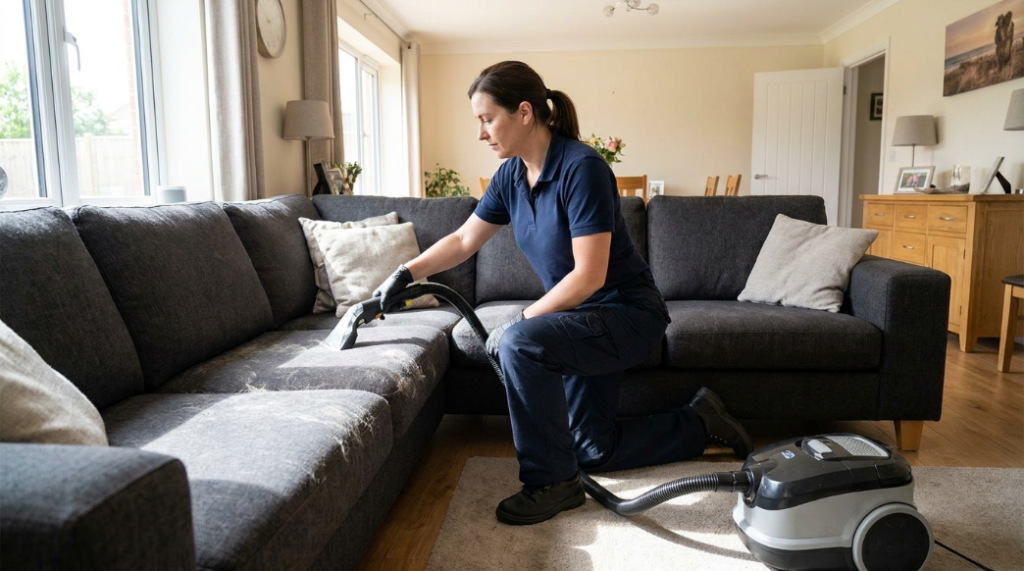
Bruna’s Cleaning Services uses eco-friendly products chosen to be safe around families and pets, and our crews adjust the routine rather than running a generic checklist. Our page on regular cleaning explains what a recurring visit covers room by room, which is a useful baseline before you add the dog specific work on top.
How Often Should You Book House Cleaning With Dogs?
Most dog households settle on every two weeks, and heavy shedders often need weekly attention on floors and upholstery. That is the pattern we see across the homes our crews handle in Wilmington, Newark, Bear, and Middletown.
Coat type drives the schedule more than anything else. A short-coated dog on hardwood is mostly a floor job. A double-coated shepherd on wall-to-wall carpet means upholstery, vents, and baseboards every single visit.
Season shifts it too. Spring and fall shedding stack on top of spring mud and fall leaves, so the same house that runs fine on a monthly schedule in January can fall behind in April. Summer humidity in this region makes odor more noticeable in carpet and dog bedding than the same amount of dirt would in winter.
Also weigh how many dogs you have, whether they are allowed on furniture, and how much of your floor is carpet. You can see the kind of work our crews post on Instagram, and our about page covers how the company operates.
What a Typical Visit Looks Like in a Dog Household
The scenario below is a composite of visits our crews handle regularly. It is not a specific named client.
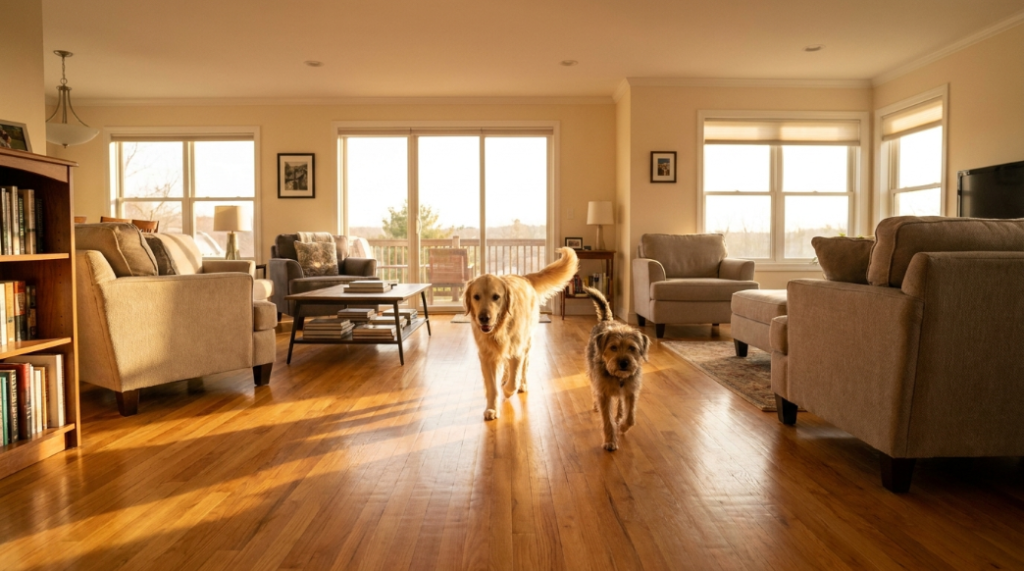
Picture a townhouse in Bear with two dogs, a golden retriever and a smaller mixed breed who walk at Lums Pond most weekends. The owner used to shut both dogs in the laundry room for the whole visit. The golden barked for two hours straight, and the floors picked up paw prints within minutes of the crew leaving, because both dogs came out the moment that door opened.
One change fixed both problems. A family member now takes the dogs out for a 45 minute walk that starts when the crew begins floors. The dogs come back to a house where the hard surfaces are already dry. Nobody barks for two hours, and nothing gets tracked across a damp floor.
The crew adjusted too. Upholstery and stairs get vacuumed before floors. In winter, the back-door mat and the first stretch of hallway get treated for salt residue before anything else happens. Pet owners come up constantly in the feedback on our Google Business Profile, and the themes repeat: hair lifted off furniture, and knowing what went on the floors.
House Cleaning With Dogs: Questions We Get Before the First Visit
Is a pet-friendly cleaning service actually different from a regular one?
A pet-friendly cleaning service differs in three concrete ways: product choice, equipment, and sequence. Products are picked so that residue on floors is not a problem for a dog who licks his paws, and HEPA filtration vacuums replace standard household models. Soft surfaces also get cleaned before floors, so lifted hair does not resettle onto a finished room.
Can I leave my dog loose in the house during the cleaning?
Yes, if your dog stays calm around strangers, ignores vacuum noise, and keeps out of rooms being actively cleaned. The two hard limits are wet floors and any history of guarding, snapping, or bolting, since crews prop doors while carrying equipment. Make the first visit the cautious one and loosen the setup once you have seen how he reacts.
How often should a home with two shedding dogs be cleaned?
Two shedding dogs usually need a professional visit every one to two weeks, and weekly is more realistic during spring and fall shedding. Hair embedded in upholstery drives that interval, not floor dirt, because floors can be swept between visits and fabric cannot. Homes with wall-to-wall carpet, or anyone in the household with allergies, should start at weekly rather than treat it as an upgrade.
Why does my house still smell like dog after a cleaning?
Lingering dog odor usually traces back to soft items nobody laundered: the dog bed, blankets, fabric toys, and the cushions he sleeps on. Odor lives in fabric and carpet padding, not on the hard surfaces that get wiped down. Old urine spots are the other source, and they need enzyme treatment, because a general purpose cleaner does not break down the compounds causing the smell.
What affects the cost of house cleaning with dogs?
The factors that move the cost of house cleaning with dogs are square footage, the ratio of carpet to hard flooring, how many dogs live there, whether they are allowed on furniture, and how often you book. Shedding season and accident history add time to the same set of rooms. Frequency has the largest effect over time, since a home cleaned every two weeks needs less work per visit than the same home cleaned quarterly.
What should I ask a cleaning company before booking if I have a dog?
Ask what products go on your floors, how long your dog should stay off them, whether the vacuums use HEPA filtration, and how urine spots get treated. Ask whether the same technicians return each visit, because a dog who recognizes the crew reacts better than one meeting strangers every time. The answers show quickly whether pet households are planned for or simply tolerated.
Getting Ready for Your First Visit
House cleaning with dogs comes down to three decisions you make before anyone picks up a vacuum: tell the company about your dog, choose where he will be, and respect the drying window on the way out. Get those right and the visit is uneventful, which is exactly what you want it to be.
Bruna’s Cleaning Services works with dog households across Delaware, Pennsylvania, and New Jersey, from Newport and Wilmington out to West Chester and Salem. You can also find us on Facebook. When you are ready, get in touch and tell us about your dog, and we will plan the visit so that house cleaning with dogs in the home is a normal Tuesday rather than a production.
Bruna’s Cleaning Services
300 Cassidy Drive, Suite #305, Newport, DE, 19804, United States
Phone: +1 302-500-9137
Email: info@brunascleaningservice.com
Hours: Mon to Thu 7:30 AM to 5:30 PM, Fri 7:30 AM to 5:00 PM, Sat 8:00 AM to 2:00 PM, Sun Closed
